
Foreign Affairs
The world we live in is largely the result of immense American efforts on the international stage over the past 75 years. American preeminence began in World War II, came of age during the Cold War, and persists today despite the follies of our post-Cold War unipolar moment and growing challenges from Moscow and Beijing. Our record is not perfect, but the United States has been a tremendous force for good in the world. We should not be the world’s policeman and must better align our finite resources with the most pressing challenges to our national interests, but disengagement and ceding sovereignty to international governmental organizations are not the answers either. We must put our fiscal house in order, preserve and strengthen our alliances, and maintain a decisive military deterrent.
As a member of the Senate Committee on Foreign Relations from 2013 to 2022 and Chairman/Ranking Member of the Subcommittee for Europe and Regional Security Cooperation, I saw what happens when the United States is perceived as either weak, disengaged, or both. I also saw what happens when the United States pursues geopolitical adventures beyond the remit of its vital national interests. The catastrophe in Ukraine is a tragic example. Post-Soviet U.S. policy in Eastern Europe vacillated between reckless assertions of influence—calling for NATO expansion into Georgia and Ukraine in 2008—and periods of disinterest and wishful thinking regarding Russian intentions in the region—Obama’s “Russian reset” in 2009-2013. In essence, we first alarmed an already resurgent, revanchist Russia and then presented it with a gaping power vacuum. Vladimir Putin was all too willing to fill it, and Ukraine has paid a terrible price.
U.S. foreign policy must reestablish coherence between our vital interests and the resources in which we invest to secure them. There is broad bipartisan consensus that the People’s Republic of China is by far the greatest foreign threat currently facing the United States. Unfortunately, there is less recognition that our unsustainable debt and deficit spending are even more fundamental threats to our security. This year, for the first time, the cost of servicing our debt exceeded what we spend on defense, a threshold that has historically heralded the decline of powerful nation-states. That leaves us with two broad objectives: first, we must balance our budget and reduce our debt, and second, we must better focus our resources on deterring Beijing.
It is important to refrain from partisan politics in foreign affairs, and I support the president’s international initiatives whenever possible, regardless of which party is in the White House. That said, the Constitution divides foreign policy-making power between the president and the Senate. The president is the primary actor on the international stage, but the Senate was given shared authority over treaties and the diplomatic recognition of other states. When the president pursues international agreements that are at odds with American values and tradition or would be opposed by a majority of the American people, the Senate has a responsibility to check the executive branch. The Kyoto Protocol on Climate Change, the U.N. Conference on the Arms Trade Treaty, the U.N. Convention on the Law of the Sea Treaty, the Paris Agreement on climate, and the recent World Health Organization Pandemic Agreement are prime examples. International accords of such magnitude should be regarded as treaties requiring two-thirds of the Senate for passage, and I have spearheaded multiple efforts to assert the Senate’s prerogative in such matters. I will continue to work to ensure that the Senate does not abrogate its constitutional duty.
Foreign relations activities and legislation I have sponsored or cosponsored:
-
-
- S. 1983 No WHO Pandemic Preparedness Treaty Without Senate Approval Act – a bill deeming any WHO pandemic preparedness agreement a treaty requiring Senate advice and consent.
- S. 472 (118th) – a bill deeming any agreement relating to Iran’s nuclear program a treaty requiring Senate advice and consent.
- S. 1441 (116th) – a bill imposing sanctions designed to prevent completion of the Nord Stream 2 pipeline.
- S. Res. 27 (116th) — A resolution calling for a prompt multinational freedom of navigation operation in the Black Sea and urging the cancellation of the Nord Stream 2 pipeline.
- Led numerous Congressional delegations to Ukraine and the Balkans aimed at strengthening transatlantic relations.
- Was the only U.S. Senator to attend Volodymyr Zelensky’s inauguration as President of Ukraine.
- Congressional Representative to the 69th, 71st, and 73rd UN General Assembly Sessions.
-
Related News

ICYMI: Sen. Johnson: The Mainstream Media is Part and Parcel of the Democrat Party
Joins ‘Hannity,' and ‘Rob Schmitt Tonight' to discuss media bias covering COVID-19 origins and Biden administrationWASHINGTON — On Wednesday, U.S. Sen. Ron Johnson (R-Wis.) joined Fox News'...
Sen. Johnson: Any Agreement with Iran Involves Risks That Affect Our Entire Nation
Leads amendment to place constitutional check on Iran dealWASHINGTON — U.S. Sen. Ron Johnson (R-Wis.) along with Senators James Risch (R-Idaho), John Barrasso (R-Wyo.), Ted Cruz (R-Texas) and...
Sen. Johnson: More Than Ever The U.S. Must Stand Unequivocally In Support of Israel
Signs on to Resolution in Support of U.S. Arms Sales to IsraelWASHINGTON — U.S. Sen. Ron Johnson (R-Wis.), member of the Senate Foreign Relations Committee, signed on to a resolution introduced by...
Sens. Johnson, Paul, Lankford, Scott, Cotton, Marshall and Rep. Gallagher Request Information on National Institutes of Health’s Funding of Gain of Function Research
Request comes amid continued questions surrounding the origins of SARS-CoV-2 and the COVID-19 pandemic WASHINGTON — U.S. Sen. Ron Johnson (R-Wis.) on Thursday joined by Sens. Paul (R-Ky.),...
Democrats Block Sens. Ron Johnson, Rick Scott Amendment to Hold Communist China Accountable, Promote Fiscal Responsibility
WASHINGTON - On Wednesday, the United States Senate voted on Senator Ron Johnson (R-Wis.) and Senator Rick Scott's (R-Fla.) amendment with Senators Marsha Blackburn (R-Tenn.), Cynthia Lummis...
Sen. Johnson: Israel has Every Right to Defend Itself
Joins Sen. Scott and colleagues on resolution reaffirming U.S. commitment to Israel WASHINGTON — Sen. Ron Johnson (R-Wis.) on Monday joined Sen. Rick Scott of Florida and 17 other Republican...
Sen. Johnson Joins Sen. Rubio, Republican Colleagues in Urging Administration To Unequivocally Support Israel’s Right to Defend Itself Against Terrorist Attacks
Sends letter to President Biden to end negotiations with Iran due to their support of HamasWASHINGTON - U.S. Sen. Ron Johnson (R-Wis.) joined Sen. Rubio and 42 other Republican colleagues in sending...
ICYMI: Johnson Talks Fake Russia Collusion Narrative, Mainstream Media Bias on ‘Fox News’
WASHINGTON - During an interview with Sean Hannity on Fox News Tuesday, U.S. Sen. Ron Johnson (R-Wis.) commented on the mainstream media's bias toward Republicans and their repeated attempts to push...
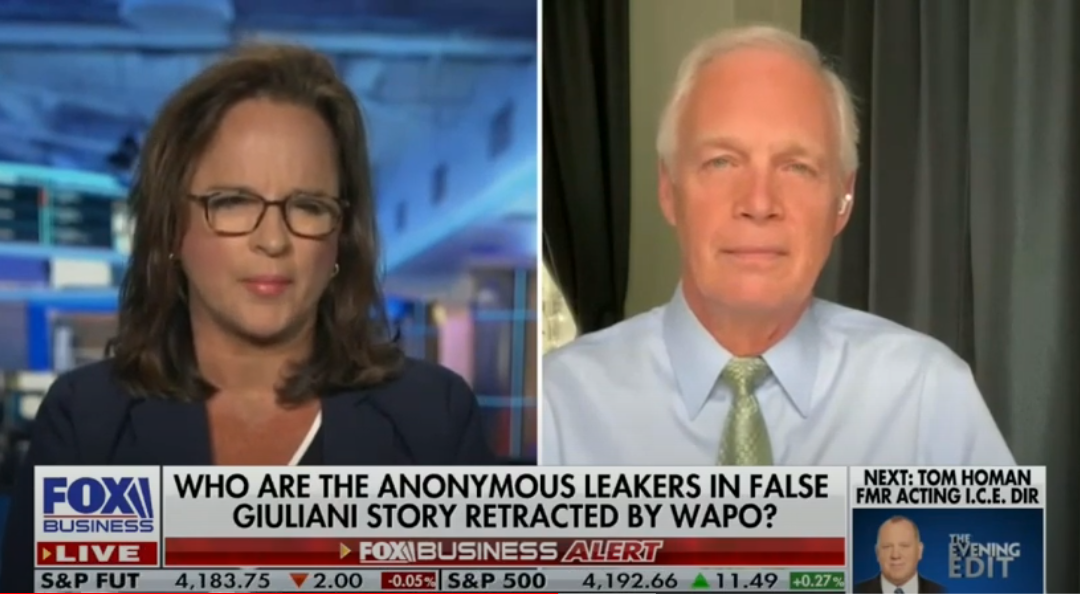
Johnson Discusses the Media’s False Russia Collusion Narrative
WASHINGTON - During a Monday appearance on The Evening Edit, U.S. Sen. Ron Johnson (R-WI) discussed the mainstream media's repeated use of faulty sources to push their false collusion narrative.A...
Johnson, Shaheen, Risch Introduce Bipartisan Resolution in Support of Full Implementation of Georgia’s April 19th Agreement to Strengthen its Democracy
WASHINGTON - Today, U.S. Sen. Ron Johnson, ranking member on the SFRC Subcommittee on Europe and Regional Security Cooperation, (R-Wis.) along with Sens. Jeanne Shaheen, Chair of the SFRC...